Risk Engine
Why a 2% Max Risk Cap Must Be Enforced Deterministically
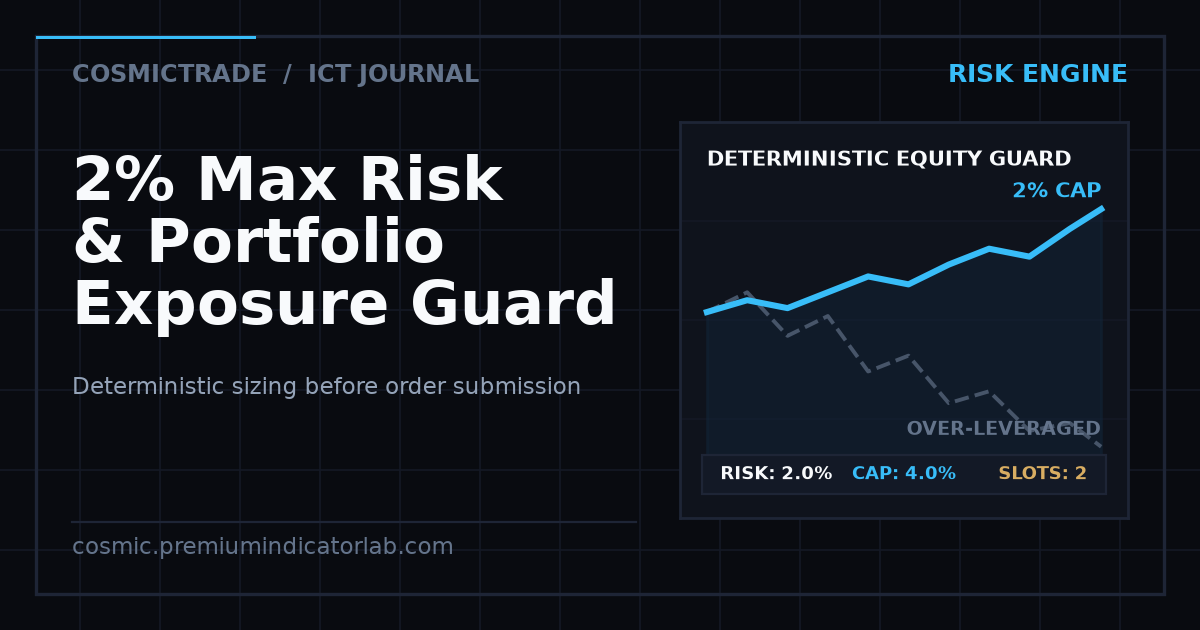
How a deterministic risk process sizes positions under a 2% per-trade cap and 4% simultaneous exposure ceiling.
What does 2 percent risk management per trade mean?
A 2 percent risk management per trade cap means the planned loss on one position must stay within 2% of the account basis defined by policy. It is a ceiling, not a target. Size the position from permitted risk, entry-to-stop distance, instrument value, and broker contract terms; do not choose a lot first and move the stop to fit.
At CosmicTrade, Mbak Sri queries a deterministic risk engine that evaluates order eligibility mathematically. This separates proposal drafting from risk approval: the check does not depend on a model's opinion or confidence. Approval still cannot guarantee that a stop will fill at its planned price, particularly during gaps, volatility, or limited liquidity.
Why sizing matters more than confidence
A chart setup that looks clean can still create a large loss if position size is excessive. Overconfidence after wins, revenge trading, or ignoring stop distance can make actual exposure diverge from the plan. Define structural invalidation first, then calculate a compatible position size. If the broker's minimum size would breach the risk limit, the trade is not viable under that configuration.
Calculations also need to account for account currency, tick or point value, contract size, spread, commission, applicable swap, and possible slippage. A simple percentage formula does not replace instrument specifications. Positions in different but related markets can concentrate losses; apparent diversification is not a dependable hedge.
Three portfolio guardrails
- Maximum 2% per trade: The distance between
entryandstop_lossinforms position size, never the other way around. This is a per-position ceiling under the system's rules, not a prompt to use the full allowance. - Maximum 4% simultaneous exposure: Open-position exposure is capped at 4% under the system's calculation. When active positions reach that threshold, new proposals are blocked. Do not treat this portfolio limit as a target or capacity that should be filled.
- Ledger ticket reservation: Every execution request requires a unique reservation ticket to prevent repeated submissions from creating duplicate orders. Reservation helps control the workflow but does not remove market or broker-connectivity risk.
A practical review records the account basis, permitted cash risk, planned entry and stop, stop distance, and contract specifications. Calculate size from those inputs, then review open exposure and correlation before submitting. If price changes the plan, recalculate rather than assuming an earlier approval remains valid for a modified order. After submission, reconcile the reservation ticket with broker status so proposal and execution are not confused.
How to interpret limits without misusing them
The 2% and 4% figures are maximum guardrails in the described workflow, not a recommended risk level for everyone. Lower exposure—or no trade—may be more appropriate. Several small correlated positions can still concentrate risk; conversely, exposure below 4% does not automatically make the next proposal suitable. Consider instrument conditions, volatility, costs, and portfolio-wide risk.
Read about how an ICT proposal is screened before an order and the roles in the trading desk. Process transparency means approval and rejection reasons can be reviewed; it does not mean every assessment is assumption-free or that results are guaranteed.
Common questions and sizing mistakes
Is 2% the amount to risk on every trade? No. It is the system's maximum cap, not a target. A personal framework may use less risk or avoid a position entirely.
Does 4% exposure mean four 1% positions are always safe? No. The threshold is not a safety guarantee. Relationships between instruments, gaps, slippage, and execution can affect realized risk. Understand how the system aggregates exposure before interpreting the figure.
Which calculation errors are common? Using an unusually tight stop only to increase lot size, omitting contract value or costs, sizing a new position without accounting for existing exposure, and treating pending orders as risk-free. Document assumptions and recalculate when specifications or conditions change.
Context and disclaimer
This article describes process controls, not financial advice, a position recommendation, or a promise of profit. Leveraged trading can cause rapid losses, including losses beyond an estimate when market or broker conditions prevent execution as planned. Learn the instrument and broker terms, use only funds you can afford to put at risk, and do not increase exposure to recover losses. No limit or engine eliminates market risk.
Define invalidation first, then size the position to the risk cap; do not widen a stop to justify an oversized lot.
Three Portfolio Guardrails
- 2% hard cap per trade: The distance between
entryandstop_lossdictates lot size—never the other way around. - 4% simultaneous exposure cap: When active positions reach the portfolio threshold, new proposals are automatically blocked.
- Ledger ticket reservation: Every broker submission requires a unique reserved ticket to prevent duplicate orders.
Transparency Over Hype
We do not promise guaranteed returns. We build an auditable decision engine that logs every approval and rejection with clear reasoning.