ICT Playbook
ICT Silver Bullet & M5 Fair Value Gap (FVG) Execution Playbook
A practical guide to higher-timeframe bias, M5 Fair Value Gap context, killzone timing, and risk-aware execution without chasing price.
What is the ICT Silver Bullet M5 setup?
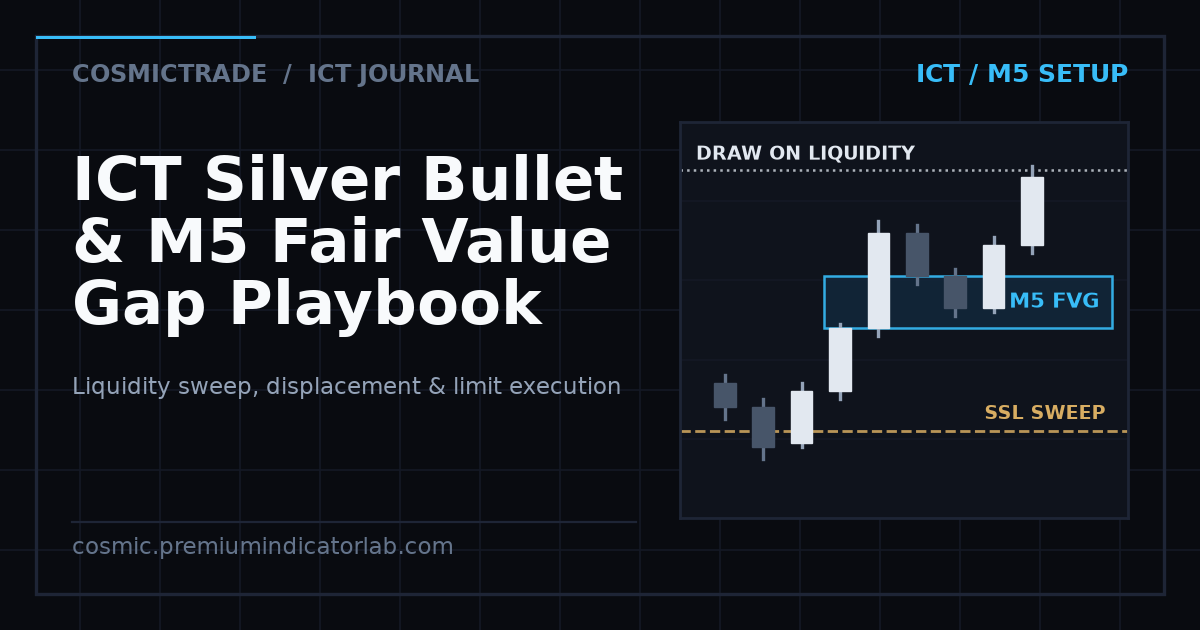
The ICT Silver Bullet strategy uses an intraday window to assess a setup in the context of liquidity and market structure—not as an automatic signal from one candle pattern. Define D1/H4/H1 bias, wait for a sweep and displacement, then evaluate the M5 Fair Value Gap (FVG). If those conditions are absent, an FVG alone is not an entry reason.
In ICT (Inner Circle Trader) terminology, an FVG represents an imbalance in a three-candle move. Traders may observe whether price retraces into that area after displacement. Silver Bullet refers to a defined intraday window in the ICT framework. Session hours and time zones should be checked against the instrument and market calendar; the name does not mean that a setup will appear or succeed. Focus only on markets and hours you can monitor appropriately.
Why higher-timeframe context matters
At CosmicTrade, Ucup scans five primary instruments (XAUUSD, BTCUSD, USDJPY, GBPUSD, GBPJPY) sequentially before passing a candidate to Bambang. This describes a screening workflow, not a recommendation to trade every instrument or a claim that each will offer an opportunity. D1 helps frame broader structure, H4/H1 provide directional and liquidity context, and M5 is used to inspect a more precise trigger. The smaller timeframe can display many convincing-looking moves that have little meaning without that context.
Before studying M5, mark relevant highs and lows, potential internal or external liquidity, and the conditions that would invalidate the bias. Do not force a directional narrative when the timeframes conflict. Waiting or standing aside is a valid decision in that situation.
A practical validation process
Use this sequence as a checklist, not as an instruction to buy or sell:
- Set the context. Review D1, H4, and H1; mark clear swings and plausible draw on liquidity (DOL). Write down the bias and its invalidation level before looking for an M5 trigger.
- Wait for a price event. During the session window you planned, observe whether price sweeps the identified liquidity. A sweep alone does not confirm a reversal or continuation.
- Look for displacement and MSS. Check for a readable impulsive move that shifts market structure (Market Structure Shift/MSS). Do not label every large candle displacement; the surrounding swing structure matters.
- Mark the M5 FVG. Confirm that the zone came from the relevant move and apply consistent boundaries. A retracement entry is only worth evaluating while the setup remains intact; price may never revisit the zone or may trade through it.
- Define risk before entry. Place the planned stop beyond a meaningful structural invalidation and size the position in relation to stop distance and account risk rules. Identify a relevant DOL target and account for transaction costs and risk-to-reward. Do not widen a stop to make a preferred position size appear viable.
- Reassess or cancel. If price has already moved too far, structure has changed, or the potential target no longer justifies the risk, do not chase. Record why you stood aside as carefully as you record a trade rationale.
From chart proposal to a guarded order
Once Bambang maps entry, stop_loss, and take_profit alongside a 16:9 chart, the proposal does not go straight to the broker. It must pass Mbak Sri's deterministic risk gate first. In practical terms, technical idea generation and risk checks are separate stages; a chart helps review levels but does not replace order or broker-condition checks. Read about per-trade risk and exposure limits and the CosmicTrade desk workflow.
Common mistakes and quick answers
Is every M5 FVG tradable? No. An FVG without higher-timeframe structure, a relevant liquidity event, displacement, or a defined invalidation plan should not be treated as a complete setup.
Must price return to the FVG? No. Price may not retrace, may trade through the zone, or may change structure before reaching it. Avoid chasing simply because a possible entry was missed.
Which mistakes can be avoided? Drawing an FVG after a move without consistent rules, treating a sweep as a guaranteed reversal, overlooking spreads or scheduled news, and moving a stop after entry in the hope that price will recover. Apply the same definitions to historical charts and live decisions so hindsight does not rewrite the rules.
Risk and responsible use
This material is educational, not financial advice or a trade signal. Trading forex, metals, and digital assets involves substantial risk; leverage can magnify losses, and stops may not fill at the expected price during fast markets. Test your understanding with appropriate data, account for costs and risk limits, and do not trade money you cannot afford to lose. No setup or process guarantees profit.
If the sweep, displacement, and invalidation are unclear, skip the entry; no FVG requires a trade.