Risk & Discipline
Why Most Traders Lose Money: 7 Root Causes & How to Fix
Why do 70%–89% of retail traders lose money? Examine the 7 root causes—from over-leveraging and moving stops to drawdown math—and how to fix them.
Why do most retail traders lose money?
Most retail traders lose money not because they lack chart indicators or cannot read direction, but because of weak risk management paired with emotional execution under pressure. Regulatory disclosures required by authorities such as ESMA and the FCA consistently show that roughly 70% to 89% of retail CFD and forex accounts lose money. Without hard risk boundaries, a handful of undisciplined trades can erase weeks of careful gains.
The paradox of accurate entries and shrinking accounts
One of the most frustrating experiences in trading is posting a solid win rate for several weeks, only to watch the account balance trend lower. In leveraged forex and commodities, chart reading is only one piece of survival. What actually determines longevity is position sizing, stop-loss discipline, Risk-to-Reward (R:R) asymmetry, and emotional restraint when price moves fast.
When a trader treats each position as an ego test rather than a statistical event, the core rules of capital preservation are the first things to break.
7 root causes behind retail trading losses
1. Over-leveraging and oversized positions
High leverage magnifies both gains and losses. Chasing fast returns tempts traders into sizing lots far beyond what their equity can absorb. Under those conditions, routine market noise or a brief spread spike is enough to trigger a margin call before the structural thesis even plays out.
2. Omitting or widening stop losses
Many traders skip stop-loss (SL) orders out of fear of being wicked out right before a reversal. Even more damaging is widening or deleting a stop once a trade moves into drawdown (loss aversion). That single habit converts a bounded, planned loss into open-ended account risk.
3. Ignoring Risk-to-Reward ratios (R:R)
Risking $100 to target $20 feels comfortable because small targets hit frequently. Mathematically, however, a negative R:R requires an unrealistic win rate just to break even: one or two full stop-outs can wipe out a long string of small wins.
4. Revenge trading after a loss
The sting of losing money triggers an urge to win it back immediately. A tilted trader increases lot size, abandons structure criteria, and forces entries outside liquid sessions. Instead of recovering equity, revenge trading accelerates the drawdown spiral.
5. Overtrading and chasing FOMO
Sharp impulsive candles trigger Fear of Missing Out (FOMO). Traders chase extended moves late, enter as spreads widen, and stack low-quality setups. Transaction costs accumulate while average setup quality drops.
6. Lacking a daily loss cap and stand-aside rule
Without a daily loss limit or an explicit rule for staying flat, one erratic or choppy session can undo months of steady discipline. Staying out of the market (standing aside) is a valid, often undervalued trading decision.
7. Strategy hopping during normal losing streaks
Every valid strategy experiences statistical losing streaks. Traders caught in "Holy Grail" syndrome abandon their ruleset after two or three losses, never collecting enough consistent sample data to evaluate what actually needs refinement.
The asymmetric math of drawdown recovery
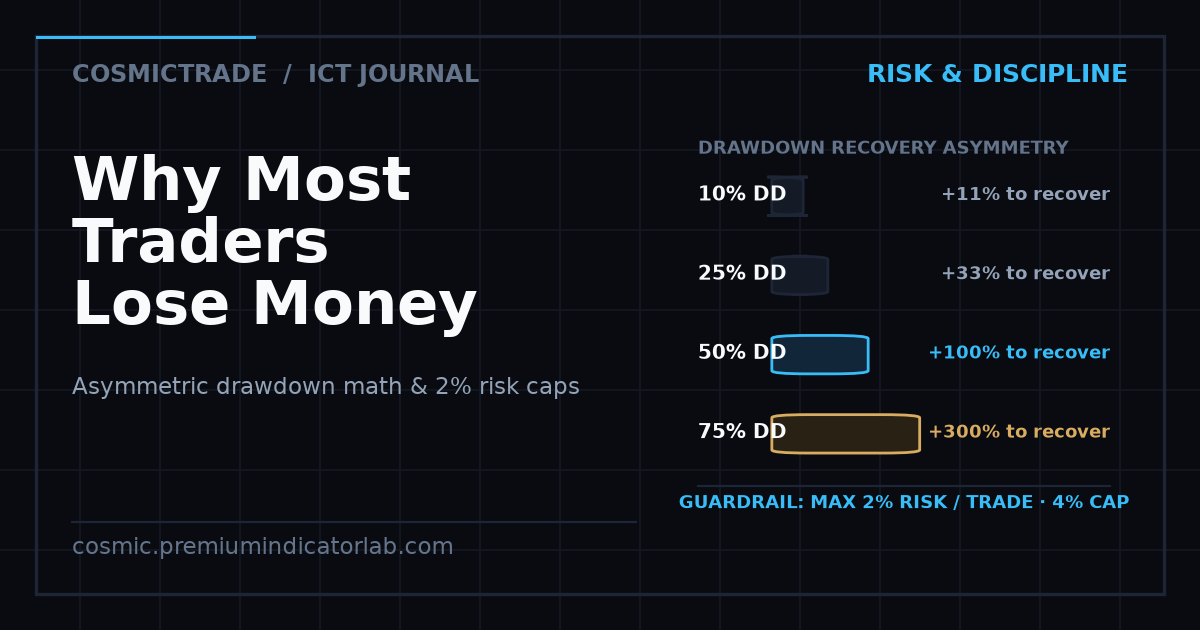
A major technical reason losses hurt more than gains is the compounding math of recovery. As drawdown deepens, the return required just to reach breakeven grows non-linearly:
| Account Drawdown | Gain Required to Breakeven | Recovery Difficulty |
|---|---|---|
| 10% | 11.1% | Mild — manageable with normal sizing |
| 25% | 33.3% | Moderate — requires strict discipline |
| 50% | 100.0% | Severe — account must double just to recover |
| 75% | 300.0% | Critical — heavy psychological pressure |
| 90% | 900.0% | Nearly impossible without extreme risk |
This asymmetry explains why keeping every individual loss small is the primary objective of risk management.
How rule-bound workflows break the loss cycle
Breaking these seven habits requires guardrails that cannot be overridden in the heat of the moment. Inside TradeMeNow's autonomous trading desk (CosmicTrade), those principles are enforced directly in code:
- Explicit stand-aside discipline: Before any setup is drafted, Pulsar (Market Scout) checks live spreads and detects abnormal volatility (
m5_volatility_spike). If structure is unclear or spreads widen past limits, the cycle halts without forcing a trade. - Cancelling stale setups instead of hoping: Quasar (Chart Strategist) reviews resting pending orders and recommends cancellation when structure invalidates, rather than letting stale limit orders sit exposed.
- Deterministic risk caps: Horizon (Risk Guardian) enforces a hard 2% maximum risk per trade, 4% simultaneous exposure limit, and minimum R:R gates in the SQLite risk ledger (
crew_ledger.db)—controls no language model can bypass. - Pre-send price & stop geometry guard: Nova (Trade Operator) runs a local pre-send check against live MT5 quotes so stale limit entries or invalid stops are rejected locally without chasing price.
- Structured post-trade lessons: Nebula (Trade Mentor) records objective lessons into
crew_lessonswhenever the 10-second lifecycle monitor closes a position, turning losses into documented rule adjustments rather than revenge trades.
Explore our 2% risk and 4% exposure guide, review when to stay flat in the ICT no-trade checklist, and see how all six roles coordinate in the five-agent autonomous trading desk overview.
Frequently asked questions
Is a bad strategy the main reason traders lose money?
Not always. Many losing traders identify reasonable price levels, yet still blow accounts due to oversized lots, widened stop losses, or revenge trading after a normal loss.
How much should a trader risk per trade?
Many disciplined practitioners cap risk at 1% to 2% of account equity per trade. At 2% or less, a string of losses remains survivable and avoids the steep drawdown recovery curve.
When should a trader stop trading for the day?
Stop immediately when you hit your daily loss cap, feel an urge to win back a loss quickly, or observe abnormal spreads and erratic price spikes.
Closing perspective and risk notice
Long-term survival in trading is rarely about how often you are right on a single day; it is about how small your losses stay when your thesis is wrong. You can inspect how our multi-role desk documents risk limits and cycle trails on the TradeMeNow home page.
Leveraged trading carries a substantial risk of capital loss. This article is educational material on risk management and system workflows, not financial advice or a promise of profits or win rates.
Your primary job as a trader is not to predict every candle correctly, but to keep losses bounded whenever the market invalidates your plan.