ICT Playbook
GBPJPY: Reading an Asian Range Sweep in London
Learn how to mark GBPJPY’s Asian high and low, distinguish a liquidity sweep from a breakout, and wait for structure confirmation instead of chasing price.
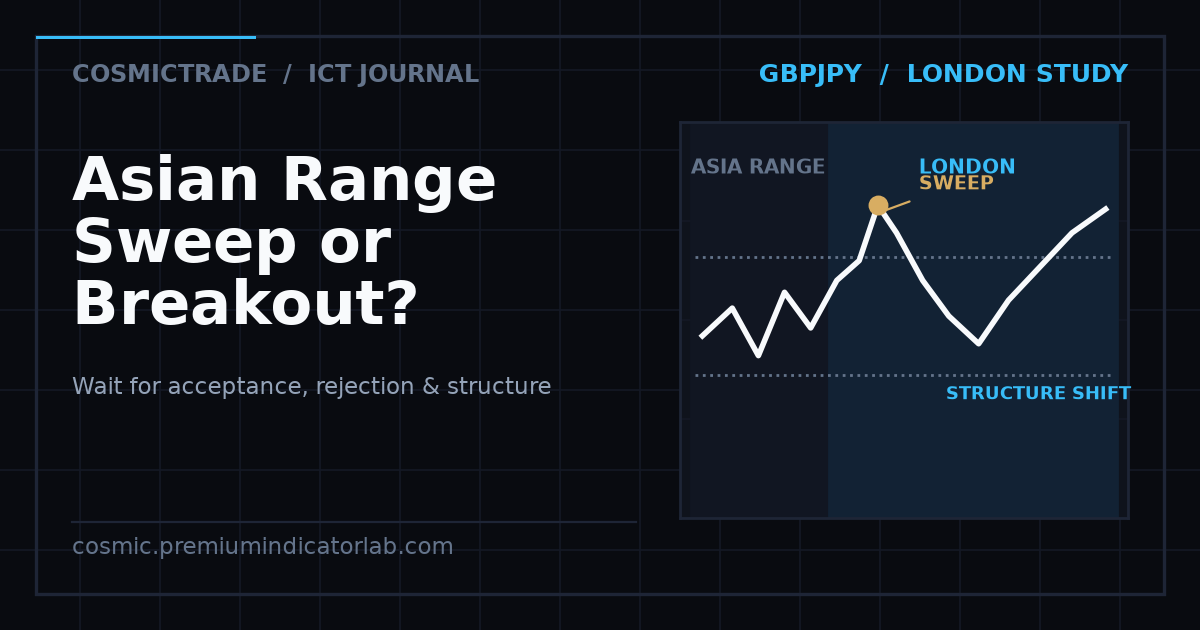
How do you read a GBPJPY Asian range sweep during London?
Mark the high and low formed during a consistently defined Asian range. During London, price moving beyond one boundary and then closing back inside may be a liquidity-sweep candidate, not an entry signal. Wait for a structural response and displacement, then define invalidation and risk. If price holds outside the boundary, consider a breakout or no-trade condition instead; a sweep is never guaranteed.
What separates a sweep from a breakout?
A liquidity sweep describes price moving through orders around a swing high or low and failing to hold beyond that level. On GBPJPY, a wick above the Asian high followed by a close back below it may indicate rejection. One wick does not prove intent or guarantee reversal, however. Assess candle closes, subsequent structure, volatility, and the higher-timeframe context.
A breakout shows acceptance beyond the range boundary—for example, multiple candles holding above the high while bullish structure continues. Price behavior can change, so do not relabel a failed breakout as a “sweep” merely to preserve a directional bias. Let subsequent evidence invalidate the idea. GBPJPY spreads and volatility can make wicks appear pronounced; use a consistent chart feed when reviewing observations.
A step-by-step GBPJPY review
- Define the Asian range: choose start and end times based on your chart’s time zone, record them, and keep the definition consistent when comparing sessions.
- Mark reference liquidity: plot the Asian high and low and any relevant levels such as the previous day’s high or low. Avoid cluttering the chart with levels that have no clear purpose.
- Observe London without assuming an outcome: note whether price approaches, crosses, or accepts beyond a boundary. London does not have to test either side.
- Evaluate the response, not just the wick: look for a close back inside or evidence of acceptance outside. Check higher-timeframe structure before drawing a directional conclusion.
- Wait for measurable confirmation: after a possible sweep, look for a market structure shift (MSS) and displacement. A Fair Value Gap (FVG) may help describe imbalance, but it does not validate a setup by itself.
- Plan risk or stand aside: decide what invalidates the idea and size the position before entry; account for spread, slippage, and stop distance. If the risk is not sensible, do not force a trade.
- Record observations neutrally: log the time, conditions, decision, and outcome in risk units. Do not save only examples that support the original hypothesis.
A disciplined plan accepts that GBPJPY may not sweep the Asian range today; refusing to chase price is also a trading decision.
Risks and limits of interpretation
GBPJPY can move sharply as liquidity changes or pound- and yen-related news is released. Volatility alone does not prove that a sweep occurred, and fast movement can increase slippage. Check the economic calendar and do not open a position merely because price crossed a range boundary. If candles hold outside the range, wait for more information or treat the sweep scenario as invalid.
“Liquidity sweep” is a framework for describing price behavior, not certainty about who traded or why orders were placed. Keep the label provisional until the confirmation you defined in advance appears. This approach does not guarantee a reversal, win rate, or any particular result; trading carries risk of loss.
FAQ
What hours should I use to mark the GBPJPY Asian range?
There is no single universal definition. Choose an Asian interval consistent with your session convention and chart time zone, then keep it fixed when testing or comparing observations. Record seasonal time changes affecting other sessions.
Does London always sweep GBPJPY’s Asian high or low?
No. Price may consolidate, break and continue, or never approach either boundary. The framework helps organize scenarios; it does not predict which will occur.
How can I distinguish a sweep from a breakout?
A return inside the range after a breach can be evidence consistent with a sweep; acceptance and continuation beyond the boundary are more consistent with a breakout. Neither is established by one wick—assess closes and subsequent structure.
Are MSS or an FVG enough to enter?
Not by themselves. Consider location, timeframe, invalidation, transaction costs, and the risk plan. If evidence is incomplete, skipping is preferable to chasing a candle.
Final perspective
A useful framework is not “London always sweeps Asia,” but a reviewable process: define the range, observe whether price returns or holds outside, wait for confirmation, and calculate risk. If the sequence does not form, skipping the session is valid. Also read our 2% risk-management guide and ICT Killzone schedule and AMD-cycle guide. This material is educational and does not guarantee results.