ICT Killzones
ICT Killzone Schedule & The AMD Cycle: Timing Institutional Moves
A practical guide to ICT Killzone windows, daylight-saving conversions, and the AMD framework without treating session timing as a signal.
What Are ICT Killzones and How Should You Use Their Schedule?
ICT Killzones are intraday windows traders use to focus attention on possible changes in liquidity; they are reference periods, not promises of movement or consistently higher volume. Their clock times depend on the time zone used and can shift against local clocks during daylight-saving time (DST). Convert the relevant London or New York local time for each season, then assess the chart and market context before planning a trade.
Core ICT Killzone Windows
These are commonly used approximate windows, not universal boundaries. Definitions vary across educational sources, instruments, and broker charts, so choose a convention and record it rather than treating one schedule as definitive.
- Asian window (roughly 20:00–00:00 New York time): observe consolidation and mark the high and low as potential reference levels, not guaranteed future targets.
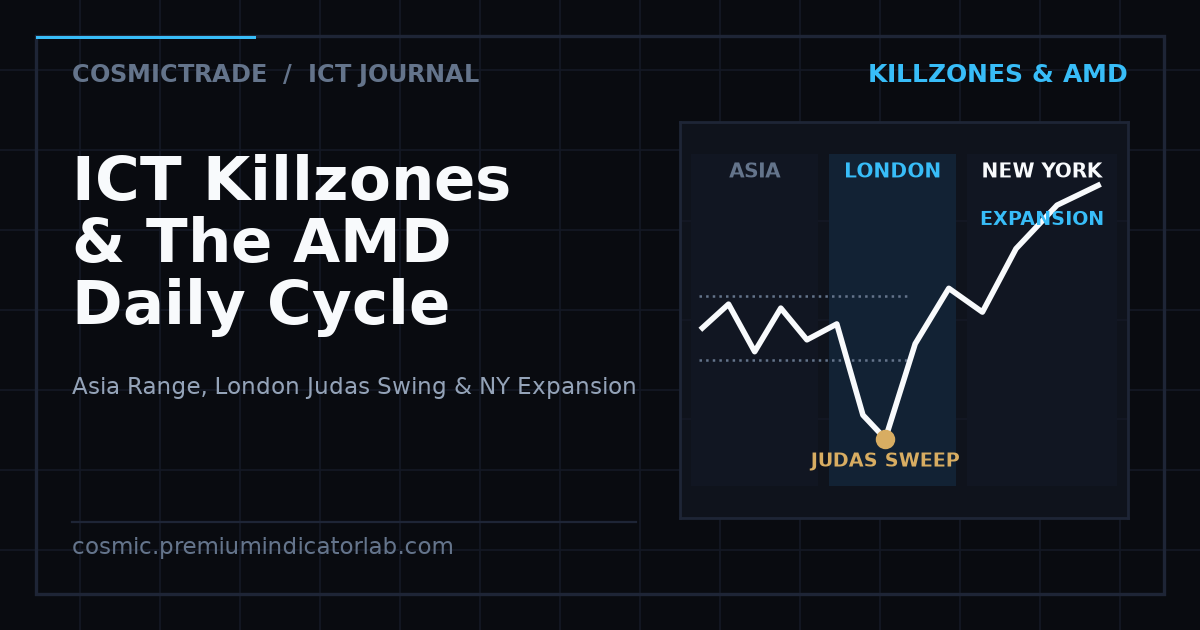
- London window (roughly 02:00–05:00 New York time): European activity may move beyond the Asian range, continue an existing direction, or remain choppy.
- New York morning (roughly 08:30–11:00 New York time): scheduled US data and the equity open can affect volatility. Check the economic calendar; conditions differ from day to day.
- London close: its New York-time conversion changes seasonally. Convert from London local time for the date in question instead of relying on a fixed offset.
The United States and Europe change clocks on different calendar dates. During those transition weeks, the difference between London, New York, and your chart’s displayed time may not match the rest of the year. Broker server time can also differ from either local clock. Check the date-specific time-zone conversion and verify the chart’s session settings before comparing historical candles. A schedule is useful only when its time basis is explicit.
The AMD Framework: Accumulation, Manipulation, Distribution
AMD, often described as Power of Three, is an interpretive framework rather than a required daily sequence. Accumulation describes a period of consolidation that may establish reference liquidity. Manipulation describes a move through a level that can challenge traders’ expectations. Distribution describes subsequent directional expansion. A market may not show all three phases, may form them in a different order, or may remain ambiguous. Apply these labels cautiously after observing price; do not force a narrative onto every session.
A step-by-step planning process
- Choose the clock: decide whether you will use New York local time, London local time, or broker time. Check seasonal offsets and note when DST changes.
- Map context: before the window, mark the Asian high and low, prior-day levels, and higher-timeframe structure.
- Observe the interaction: note whether price runs a level and returns or holds beyond the range. A wick alone does not establish a reversal.
- Wait for evidence: if a market structure shift (MSS) appears, assess displacement and any fair value gap (FVG) in context. Neither is an automatic entry signal.
- Define invalidation and risk: identify what would disprove the idea, account for spread and slippage, and size the position accordingly. Skip it if the risk cannot be defined sensibly.
- Review without hindsight: record the time, conditions, rationale, and outcome in risk units. A single chart example does not demonstrate an edge.
Discipline means accepting that a session may offer no setup: do not chase a candle or force a pattern just because a Killzone is active.
Use timing as context, not a signal
Killzones can help structure observation, while AMD can help organize an intraday hypothesis. Neither predicts direction or removes news, execution, spread, or slippage risk. After a possible sweep, wait for meaningful structure and evaluate an entry plan against its invalidation level. See our ICT Silver Bullet and M5 FVG guide, 2% risk-management guide, and GBPJPY Asian-range example. CosmicTrade’s screening framework is educational and does not guarantee trading outcomes.
FAQ
Are ICT Killzone times fixed throughout the year?
No. London and New York observe daylight-saving changes on different dates, while broker clocks may use another time zone. Convert the local session times for the relevant date and verify your chart settings.
Does a Killzone guarantee volatility or a profitable trade?
No. It is a time-based observation framework. Price may be quiet, move against an expectation, or produce no valid setup.
How is AMD different from a Killzone?
A Killzone describes a time window for observation. AMD describes a possible sequence of price behavior. One is not proof of the other, and every session need not contain all three AMD phases.
Should I enter whenever price sweeps a high or low?
No. A level being crossed is not enough to establish reversal or continuation. Wait for context and confirmation, define invalidation and risk, or stand aside.
Final perspective
Use the schedule to prepare your observation, not to forecast the next candle. Recheck time-zone conversions around DST changes, read structure without forcing a label, and preserve a defined risk plan. No schedule or AMD interpretation guarantees an opportunity or a trading result.